
Inteligencia Artificial
AI evolves: from data to autonomy
The foundations of a new business architecture
Author: Imaginae Team
Date: 12/10/2025

Artificial Intelligence is undergoing a transition that goes far beyond efficiency or automation. A distributed, collaborative, and autonomous architecture is emerging, capable of making decisions, coordinating processes, and improving with each iteration.
This trend—which is increasingly visible in the global technology industry—marks the beginning of a completely new operating model for organizations.
Below are the six stages that explain this evolution, which are interconnected and culminate in a structural leap: AI ceases to be a tool and becomes the cognitive infrastructure of the company.
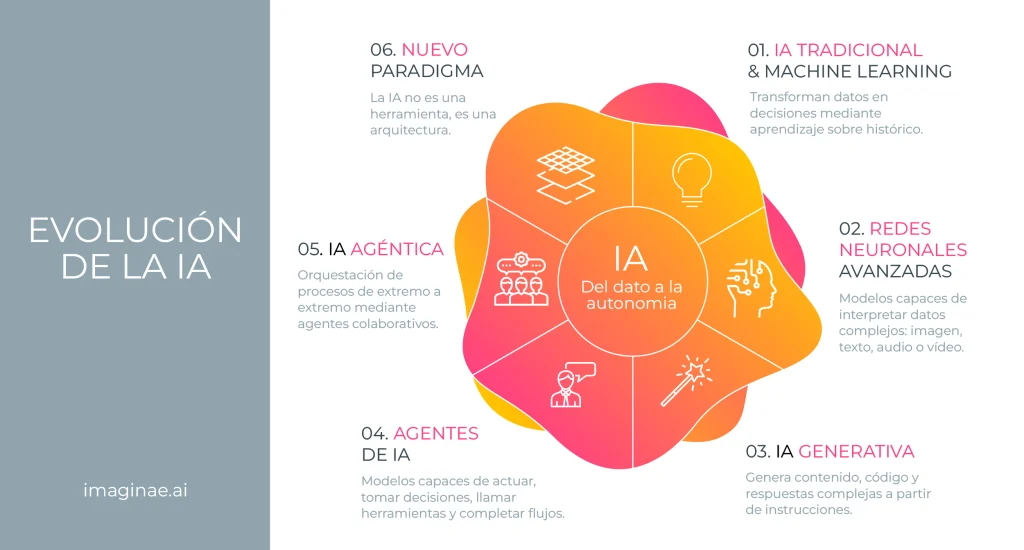
01. TRADITIONAL AI & MACHINE LEARNING
The foundation on which the first wave of adoption was built. Models capable of converting data into decisions through historical-based learning.
Most common uses:
- Demand forecasting
- Customer segmentation
- Price optimization
- Anomaly detection
This approach remains essential, but it is no longer sufficient for managing complex environments.
02. ADVANCED NEURAL NETWORKS
This is where AI’s ability to interpret unstructured data—images, text, audio, or video—comes into play. It is the stage that enabled the explosion of computer vision, voice recognition, and deep contextual understanding.
Key milestones:
- Convolutional neural networks (CNNs)
- Recurrent networks (RNNs, LSTMs)
- Transfer learning
- Initial multimodality
Opens doors to entire industries: visual diagnostics in health, safety, automated inspection, etc.
03. GENERATIVE AI
The great cultural and productive leap forward. Models capable of creating content, structured reasoning, and code with unprecedented speed and quality.
Cross-cutting impact:
- Marketing, sales, and communication
- Software development and QA
- Support and documentation
- Applied creativity: scripts, images, videos, simulations
In addition, thanks to RAG (Retrieval-Augmented Generation), companies can connect their own data to the model.
04. AI AGENTS
AI is no longer limited to generating responses; it now does things. Agents are systems that execute complete flows: they plan, call tools, interact with APIs, maintain context, and make decisions.
Current uses:
- IT automation
- Continuous commercial prospecting
- Management of complex requests
- Assisted research
It is the turning point between “using AI” and “delegating tasks” to AI.
05. AGENTIC AI
The stage that drives the world’s most advanced companies today. Systems where multiple agents collaborate, correct each other, distribute work, and orchestrate end-to-end processes.
Distinctive capabilities:
- Multi-agent coordination
- Long cycle autonomy
- Self-assessment and iterative improvement
- Deep observability and traceability
- Management of independent resources and objectives
This level allows you to automate entire processes: from modernizing software to managing interdepartmental operations.
06. NEW PARADIGM
Closing the loop is not a technology, but a new way of building companies. AI becomes:
- Part of the organization’s nervous system,
- A cognitive fabric that orchestrates information,
- An infrastructure that learns from itself.
As recent analyses by MIT Technology Review and McKinsey point out, competitive advantage will no longer come from adopting models, but from integrating them into living, autonomous architectures.
AI is evolving, yes. But what’s most important is that the company is evolving with it.
Follow us on our LinkedIn page
View other entries
-
Imaginae will participate as a technology partner in the NAIVE project, which has been awarded an ERC Proof of Concept grant
-
Imaginae participará como partner tecnológico en el proyecto NAIVE, reconocido con una ayuda ERC Proof of Concept
-
Predictive maintenance in industry: how AI and WonzsAi Industry are transforming efficiency
-
Mantenimiento predictivo en la industria: cómo la IA y WonzsAi Industry transforman la eficiencia
-
MCP: Are we facing the new “common language” of Artificial Intelligence?
